This is a review of the DVD. Much of the following material was first written at OmegaCon, a one-time event I attended in Birmingham, AL.
And so, having promised myself (and the lady herself) that I would do so, I headed for the screening of Yesterday Was a Lie, starring Chase Masterson. One of the reasons I gave this movie a shot, aside from its concept (altered states of reality, SF-film noir) was that James Kerwin, the writer/director, was an astronomy minor, and so knew what he was talking about, at least in theory. Brother, did he ever!
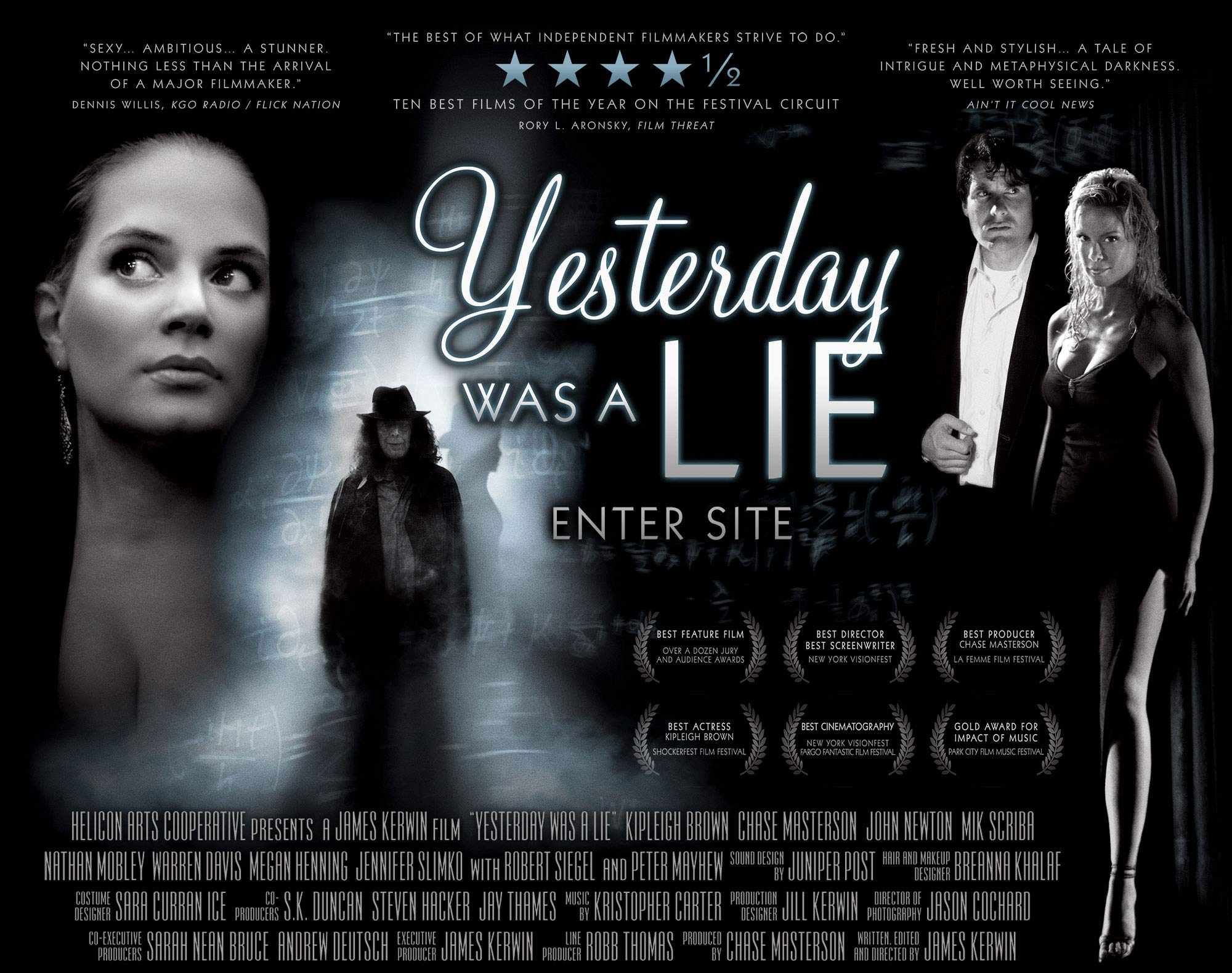
This was a seriously amazing movie. Way too smart for Hollywood, which is probably why it's had a hard time getting into some film festivals. Try this for a multi-layered movie: you've got a black-and-white film noir with dark, brooding cinematography to match the quality of anything made "back in the day." You've got a troubled, hard-bitten, hard-drinking female detective who's having seriously bad cases of deja vu or disjointed experiences that come out of nowhere. You've got a mysterious man who appears to hold the secrets to all of this. You've got Peter Mayhew as an equally mysterious, dangerous figure. Somewhere in the mix, you've got a love story. And yes, you've got Chase Masterson starring as a lounge singer with many other roles to either help explain things or make them muddier, depending on how you interpret the dialogue.
I should stress that this story is set in the present day, but it still has a lot of '40s technological artifacts, like analog telephones, old cars, and snap-brim hats. However, items like computers bring us back to the present. Thus it is what it is: a purposeful homage to film-noir set in the present day. The tone and style might evoke Raymond Chandler or The Third Man, but the story structure is more like something by Alfred Bester. As a piece of science fiction filmmaking, Yesterday Was a Lie is superb.
However, being a relentless critic, there are a couple of things that I didn't like, but they are minor, and one of them eventually corrected themselves. It took awhile to warm up to the lead character actress, Kipleigh Brown, who plays the grumpy, and at times frumpy detective, Hoyle. The '40s fedora and baggy suits don't (shall we say) suit her, but that costume isn't seen after the early part of the film. The whiskey-drinking, cigarette-smoking tough-gal act struck me as a tad ridiculous, but this, too, seems to be shed as the story develops. I asked the director afterward which scenes were shot first, because it seemed as if Brown gradually became more comfortable with the role.
The other challenge of the film is that it is, as I told the director, simply too smart for Hollywood. As a science fiction fan and occasional fan of old movies, I got it. Hell, I loved the concept! However, I might be a very niche audience. You have to be comfortable with nonlinear SF stories. And the concept is very high, the sort of thing that SF fans read SF for: to expand our minds and horizons. As such, it is entertainment of a specific type for a very specific audience. You either dig it or you don't. (I recall Ms. Masterson saying, "I love you guys!" as the audience debriefed afterward and was getting the whole concept. Apparently a few people had told her or the director, "I don't get it.")
I was pleased that the film made it to DVD production, if not general theatrical release. The director is smart and clearly has a passion for stylistics. Kipleigh Brown got more interesting in the role as the film went on and is every bit as sexy as the luminous (yeah, I said luminous--watch the film) Ms. Masterson, who is mostly known to science fiction fans for the character Leeta in Star Trek: Deep Space Nine as well as others. I hope all of the people involved in this project get to work on equally meaty films in the future. It'd do Hollywood and its audiences a lot of good.
Follow-up, 9/2/12
I posted this article via my Twitter feed and copied James Kerwin and Chase Masterson in the process. Mr. Kerwin was quick to respond (the magic of the internet!), thanking me for my comments and letting me know that Yesterday Was A Lie actually did enjoy limited release in theaters. I stand corrected. He also suggested I watch the movie with the audio commentary, which I will plan to do this weekend. The discussions during OmegaCon were quite illuminating. Anyhow, just thought I'd share.

And so, having promised myself (and the lady herself) that I would do so, I headed for the screening of Yesterday Was a Lie, starring Chase Masterson. One of the reasons I gave this movie a shot, aside from its concept (altered states of reality, SF-film noir) was that James Kerwin, the writer/director, was an astronomy minor, and so knew what he was talking about, at least in theory. Brother, did he ever!
This was a seriously amazing movie. Way too smart for Hollywood, which is probably why it's had a hard time getting into some film festivals. Try this for a multi-layered movie: you've got a black-and-white film noir with dark, brooding cinematography to match the quality of anything made "back in the day." You've got a troubled, hard-bitten, hard-drinking female detective who's having seriously bad cases of deja vu or disjointed experiences that come out of nowhere. You've got a mysterious man who appears to hold the secrets to all of this. You've got Peter Mayhew as an equally mysterious, dangerous figure. Somewhere in the mix, you've got a love story. And yes, you've got Chase Masterson starring as a lounge singer with many other roles to either help explain things or make them muddier, depending on how you interpret the dialogue.
I should stress that this story is set in the present day, but it still has a lot of '40s technological artifacts, like analog telephones, old cars, and snap-brim hats. However, items like computers bring us back to the present. Thus it is what it is: a purposeful homage to film-noir set in the present day. The tone and style might evoke Raymond Chandler or The Third Man, but the story structure is more like something by Alfred Bester. As a piece of science fiction filmmaking, Yesterday Was a Lie is superb.
However, being a relentless critic, there are a couple of things that I didn't like, but they are minor, and one of them eventually corrected themselves. It took awhile to warm up to the lead character actress, Kipleigh Brown, who plays the grumpy, and at times frumpy detective, Hoyle. The '40s fedora and baggy suits don't (shall we say) suit her, but that costume isn't seen after the early part of the film. The whiskey-drinking, cigarette-smoking tough-gal act struck me as a tad ridiculous, but this, too, seems to be shed as the story develops. I asked the director afterward which scenes were shot first, because it seemed as if Brown gradually became more comfortable with the role.
The other challenge of the film is that it is, as I told the director, simply too smart for Hollywood. As a science fiction fan and occasional fan of old movies, I got it. Hell, I loved the concept! However, I might be a very niche audience. You have to be comfortable with nonlinear SF stories. And the concept is very high, the sort of thing that SF fans read SF for: to expand our minds and horizons. As such, it is entertainment of a specific type for a very specific audience. You either dig it or you don't. (I recall Ms. Masterson saying, "I love you guys!" as the audience debriefed afterward and was getting the whole concept. Apparently a few people had told her or the director, "I don't get it.")
I was pleased that the film made it to DVD production, if not general theatrical release. The director is smart and clearly has a passion for stylistics. Kipleigh Brown got more interesting in the role as the film went on and is every bit as sexy as the luminous (yeah, I said luminous--watch the film) Ms. Masterson, who is mostly known to science fiction fans for the character Leeta in Star Trek: Deep Space Nine as well as others. I hope all of the people involved in this project get to work on equally meaty films in the future. It'd do Hollywood and its audiences a lot of good.
Follow-up, 9/2/12
I posted this article via my Twitter feed and copied James Kerwin and Chase Masterson in the process. Mr. Kerwin was quick to respond (the magic of the internet!), thanking me for my comments and letting me know that Yesterday Was A Lie actually did enjoy limited release in theaters. I stand corrected. He also suggested I watch the movie with the audio commentary, which I will plan to do this weekend. The discussions during OmegaCon were quite illuminating. Anyhow, just thought I'd share.

