Interview: Camilla Sdo
Life is beginning to return to normal, so what could be more natural than for me to conduct an interview with a rubber chicken? No, really...
First, everyone's favorite interview question: tell us about yourself.
Does everyone get along?
This is a very diverse crew and I think Fuzz enjoys being a guy between two ladies! We all have our own talents and together we are a very strong team. Just like on a real NASA space mission, it takes getting used to each other. Team work is very important and I trust my crew completely.


You mentioned that you're particularly interested in doing science, technology, engineering, and math (STEM) education and in getting women interested in STEM careers. That's a mission of ScienceCheerleader.com (one of my other side jobs) as well. What do you do to encourage young women to pursue those careers? What's your primary message?
I think we should think about doing a project together. Like I said - building a community and working together we can achieve so much. Reality is that we need to have more women in STEM. Many times they are intimidated by the subjects or they don't always get the chances they deserve. But it's so important to encourage girls to pursue that career and show them that really not even the Sky is the limit.
Darlene Cavalier, the original Science Cheerleader, does interviews with pro cheerleaders, and she asks each of them if they're taken seriously because society has certain stereotypes or perceptions about cheerleaders. You're in a similar situation, as rubber chickens are traditionally seen in a comic relief role. Do you ever worry that people won't take you seriously as an advocate for STEM? How do you counteract that?
Of course there are always people who see me as just a rubber chicken. I see that as a positive challenge. Look, I have managed to train with the very last Space Shuttle crew, the STS-135 crew. I have spent time with the NASA Administrator and we talked about public outreach. I have managed to get stuck on the Space Potty thanks to Astronaut Clay Anderson. If I can achieve all of this, I should be taken seriously. And if a girl shows interest in math or science, that girl should immediately have the respect and support.
Anything else you'd care to share?
Here is the truth: we have one Space Shuttle launch left to go. After that we will not be launching humans from the US for some time. But that does not mean space exploration is dead. The ISS (International Space Station) continues to host astronauts. They will continue to do science up there and we will continue to learn about our solar system and our universe. Some amazing unmanned missions are coming up, like Juno. Juno will help us learn more about Jupiter. http://www.nasa.gov/mission_pages/juno/main/index.html
Life is beginning to return to normal, so what could be more natural than for me to conduct an interview with a rubber chicken? No, really...

First, everyone's favorite interview question: tell us about yourself.
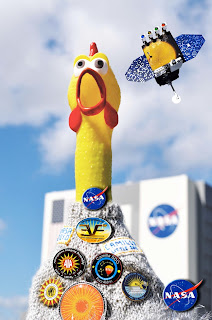
Me? I am Camilla Corona SDO - a rubber chicken turned mission mascot for NASA's Solar Dynamics Observatory or SDO. I help with the Education and Public Outreach part of our mission! Little SDO is now in his orbit taking these incredible high resolution images of the Sun in many wavelengths. These images are 10x higher resolution than HD TV and really let us take a very close look at the Sun. I met Little SDO at NASA Goddard Space Flight Center many years ago and we established this very special friendship. I call him Little but he is actually the size of a small bus. For a year we have now gotten this amazing data and have already learned a little more about our Sun.
When I am not educating about the Sun and Space Weather, I do try to inspire kids to get more interested in science, engineering and space exploration. And since I want to go and visit Little SDO in Space, I have to go through a lot of training. I really enjoy that part and it allows me to get an inside look into human space flight. And I enjoy sharing my adventures and what I am learning in the process.
Learn about Little SDO here: http://sdo.gsfc.nasa.gov/
Or follow him on Facebook here: www.facebook.com/NASA.Little.SDO
Who makes your clothes?
One of my goals is to create a community. Little SDO and I want to be as engaging and interactive on social media as possible. That creates a community of people who not only want to learn, but they want to become involved. And I always say, you don't have to be fluent to speak the language. There are many ways people can help and get involved. And so it turns out that I have some amazing friends on social media who make me these amazing outfits. And in the process they get involved. They not only learn about what I do, but they tell their friends and then they get interested. And why not combine art and science? Art is science and there is art in science. And I end up as the best dressed rubber chicken there is! A rubber chicken isn't the first mascot one might think of when it comes to space weather. How did that come about?
Rubber chickens have been an important part of NASA, dating back to the Apollo days. Back then it was more of a way to let frustration out. There are stories of engineers smashing rubber chickens against the desks. What happened on SDO is that one day I walked down the halls of Goddard Space Flight Center and I saw this shiny spacecraft and it was friendship at first sight. So I was adopted as the mission mascot. Plus, I am yellow like the Sun! (which of course is not really the case since the Sun has no color). You have quite an interesting travel schedule. What sorts of events do you attend?
I do have a very busy schedule, with not only conducting a lot of training, but I also try to attend several events to connect with the people. I enjoy events with kids because it is really wonderful to see their inspiration and see their way of thinking. And I try to inspire our youth, especially girls, to explore their interest in science, technology, engineering and math. And I try to attend most of our NASA Tweetup events, where selected individuals are invited to get a real inside look into either a Space Shuttle launch, an unmanned mission or a NASA center. These are great opportunities to meet and connect with people. The power of social media is wonderful - it gives somebody like me a voice, a way to reach out.
I do have a very busy schedule, with not only conducting a lot of training, but I also try to attend several events to connect with the people. I enjoy events with kids because it is really wonderful to see their inspiration and see their way of thinking. And I try to inspire our youth, especially girls, to explore their interest in science, technology, engineering and math. And I try to attend most of our NASA Tweetup events, where selected individuals are invited to get a real inside look into either a Space Shuttle launch, an unmanned mission or a NASA center. These are great opportunities to meet and connect with people. The power of social media is wonderful - it gives somebody like me a voice, a way to reach out.
Several NASA missions now have critters of various sorts supporting or representing their outreach efforts. Do you see this as a trend?
I wasn't the first mission critter but I am the most active for sure. There is a trend. Just very recently Trigger got introduced with NASA's MMS mission. But not only within NASA can we now find mascots. AIAA (American Institute of Aeronautics Astronautics) has Skye Bleu, Bears On Patrol has Fuzz Aldrin. Both of them are part of my mission to the Edge of Space. Then there is my dear friend Spooner with NASA's Exploration Technology Development Program Office. And I cannot forget Luna, NASA Johnson's Space Center's mascot. And Boeing has Casey. So there is trend and one that makes sense. See, our goal is to get people involved, interested and take the intimidation factor out. Put a "human" face to the missions, the science and people are sometimes more interested and feel more comfortable to ask questions. It's wonderful.
You, Fuzz Aldrin (a teddy bear), and Skye Bleu (a flying pig) went on an actual flight mission. What's all that about? What did you do?
Last year I was contacted by the non-profit organization BearsOnPatrol.org and asked if I was interested in joining forces to promote science education and peace. We decided to plan a mission to the Edge of Space and make it like a real NASA mission. We decided to use a balloon to get us to 100,000 feet, add some cameras, tracking devices and a scientific instrument and use this as a way to not only educate about what is needed for this, but to show how easy it is to reach the Edge of Space. The goal is to get beautiful images of the darkness of Space and see Earth's curve. Also, we want to inspire parents and teachers to do a similar projects with their kids. After we created the mission patch and named the mission BTS-1 (Balloon Transport System - 1st Flight) the AIAA's mascot Skye Bleu joined us. And again, this is about building a community, educating about the various steps it takes to get a mission of the ground and have fun with it. And just today we had our Pre-Flight Medical exams. Just like real astronauts we went through a series of medical tests.
I am the Commander of the mission and am responsible for the overall mission success. Fuzz Aldrin is the Pilot and has gone through many mission sims in order to get us all back safe. Skye Bleu is our Mission Specialist and will be overseeing all the instruments on board our capsule. Our capsule was just named "Inspiration" - and we hope to just do that!
Does everyone get along?
This is a very diverse crew and I think Fuzz enjoys being a guy between two ladies! We all have our own talents and together we are a very strong team. Just like on a real NASA space mission, it takes getting used to each other. Team work is very important and I trust my crew completely.
Were you nervous about the flight?
I think I was more excited than nervous. There are many things that could go wrong but we must focus on the things that will go right. It is exciting to think about going up that high. It's not a first but it's a first by three mascots.
I think I was more excited than nervous. There are many things that could go wrong but we must focus on the things that will go right. It is exciting to think about going up that high. It's not a first but it's a first by three mascots.


Now looking back at our BTS-1 mission, I am glad we trained well. Like all astronauts, we did do survival training. We landed much further East than expected and managed to touch down in gator invested swamp land in Louisiana. We were out there for almost 5 days, waiting for rescue. Our ground team did an excellent job in locating us and getting us back home safe.

This was one of the lessons we tried to teach. Sometimes things just go differently during a mission. A team needs to adjust quickly and come up with solutions. Sometimes it's a life and death situation. Look at Apollo 13! A grim situation was turned around by working together and coming up with solutions. That's spaceflight for you! Teamwork. What you don't predict, you cannot prevent.
You mentioned that you're particularly interested in doing science, technology, engineering, and math (STEM) education and in getting women interested in STEM careers. That's a mission of ScienceCheerleader.com (one of my other side jobs) as well. What do you do to encourage young women to pursue those careers? What's your primary message?
I think we should think about doing a project together. Like I said - building a community and working together we can achieve so much. Reality is that we need to have more women in STEM. Many times they are intimidated by the subjects or they don't always get the chances they deserve. But it's so important to encourage girls to pursue that career and show them that really not even the Sky is the limit.
Darlene Cavalier, the original Science Cheerleader, does interviews with pro cheerleaders, and she asks each of them if they're taken seriously because society has certain stereotypes or perceptions about cheerleaders. You're in a similar situation, as rubber chickens are traditionally seen in a comic relief role. Do you ever worry that people won't take you seriously as an advocate for STEM? How do you counteract that?
Of course there are always people who see me as just a rubber chicken. I see that as a positive challenge. Look, I have managed to train with the very last Space Shuttle crew, the STS-135 crew. I have spent time with the NASA Administrator and we talked about public outreach. I have managed to get stuck on the Space Potty thanks to Astronaut Clay Anderson. If I can achieve all of this, I should be taken seriously. And if a girl shows interest in math or science, that girl should immediately have the respect and support.
I understand you're friends with my author friend Kate Doolan, who described you as a "classy chick." What are your interactions with her like?
Bart, the social media tools have enabled me to connect and interact with a wide variety of people. I met Kate a long time ago and I see her as one of my most special friends. I love her humor and I really admire her Apollo days knowledge. While we joke around often, we both admire each other and I have learned a lot from her. I hope she can say the same. But the beauty is that I can connect with so many wonderful people. And I get a chance to learn and listen to what they think.
Anything else you'd care to share?
Here is the truth: we have one Space Shuttle launch left to go. After that we will not be launching humans from the US for some time. But that does not mean space exploration is dead. The ISS (International Space Station) continues to host astronauts. They will continue to do science up there and we will continue to learn about our solar system and our universe. Some amazing unmanned missions are coming up, like Juno. Juno will help us learn more about Jupiter. http://www.nasa.gov/mission_pages/juno/main/index.html
MAVEN and MSL will both give us more clues about Mars and its atmosphere.
Get interested, get engaged, have fun with what we do. Reality is, we don't know much and have lots of stuff to learn.
If you want to learn more about me or follow my adventures:
Thanks!


