Gooooo Laura!
Here's a follow-up to my interview with Laura Eilers, Science Cheerleader's fearless and multi-talented Creative Director and Choreographer: Darlene has done a pre-pageant interview that covers some lesser-known facts about Laura.
The pageant is in Vegas this weekend, I believe. Good luck, Laura!
Showing posts with label interview. Show all posts
Showing posts with label interview. Show all posts
Saturday, July 09, 2011

Friday, July 01, 2011
Book Review and Interview: Neda Ansari

Free are the stars in the night sky
And the occasional comets that go by
Free are the sparkles in people’s eyes
And their will to rebel, revolt and rise
 Neda is a director at the Space Renaissance Initiative, which is one of the few pro-space groups I haven’t joined because of its rather negative view of religion. These things happen. She also has posted her work in a variety of web sites related to issues in Iran. I think I first became aware of her when she started writing to a fellow Iranian (some prefer “Persian”) American, Anousheh Ansari, who joined a rather elite group of people who have been able to afford space tourism on the International Space Station. Neda is not, so far as I know, related to Anousheh. That’s rather like asking me if I’m related to any of a dozen “Leahys” from Ireland—odds are, the answer’s yes, but you’d have to go way back.
The neat part of ISDC is meeting a lot of very smart people who share a passion for space exploration. Sometimes they’re old friends, sometimes complete strangers, sometimes people I’ve wanted to meet because I knew them online or I’ve admired something they’ve done. Neda Ansari is in that third category. She is a poet.
Neda came to ISDC 2011 as participant in the authors track. I missed that track (like most of the others) because I was working. I expressed a wish to read some more of her poetry, as I only glimpsed a bit in one of the thousands of emails that zipped through my inbox, and she agreed. More than agreed, she sent a hand-bound, self-published compilation of poetry, translations, and other writings.

The title doesn’t exactly roll off the tongue, but what I found on the pages intrigued me. Here’s a random sample from a poem entitled “Hope,” which, as Neda notes, “was published on Iranian.com on April 29th, 2009, days before the Green Revolution in Iran broke.”
The light of sun was what I was after
Resonating with children’s laughter
From atop I saw a town
Filled with lights of its own
I was filled with much joy
Like a child with a new toy
Yes, I longed to see the light
To burn abyss with no fright
Resonating with children’s laughter
From atop I saw a town
Filled with lights of its own
I was filled with much joy
Like a child with a new toy
Yes, I longed to see the light
To burn abyss with no fright
And this is probably the section that won me over on Neda’s work:
Free is the wind, is the air
Free are certain things with flairFree are the stars in the night sky
And the occasional comets that go by
Free are the sparkles in people’s eyes
And their will to rebel, revolt and rise
I like the spirit in Neda’s poetry, the optimism. Her subjects range from scientific concepts (she studied chemistry) to freedom to general playfulness. What intrigued me, I must confess, were her connections to the Iranian Revolution of 1979 and the more recent “Green” Revolution. I have no idea where her family stood in 1979, though they did return to Iran from America after that revolution, and Neda spent some time under the cover of a burka. Neda’s stand in 2009 is obvious just by the tone of her writings—she believes in freedom, in aspiration, and people striving for something better. All good things.
A couple of the items in Neda’s collection were censored—presumably in Iran—and her blog is no longer online. Her response to the situation in Iran was sufficiently complicated that, for a while, she traveled under an alias in Facebook: Yeki Bood, Yeki Nabood, which is, she explained, roughly the Persian equivalent of “once upon a time.” However, directly translated, it would read more like “There once was, then there wasn’t,” which is a conversation-starter all to itself.
Neda is a director at the Space Renaissance Initiative, which is one of the few pro-space groups I haven’t joined because of its rather negative view of religion. These things happen. She also has posted her work in a variety of web sites related to issues in Iran. I think I first became aware of her when she started writing to a fellow Iranian (some prefer “Persian”) American, Anousheh Ansari, who joined a rather elite group of people who have been able to afford space tourism on the International Space Station. Neda is not, so far as I know, related to Anousheh. That’s rather like asking me if I’m related to any of a dozen “Leahys” from Ireland—odds are, the answer’s yes, but you’d have to go way back.But really, when you read Neda’s poetry, it’s difficult to determine what exactly was being censored. How often does one encounter censorship anymore—and by that I mean the removal of all or portions of a work of art by a government entity—that is different from bad poetry that no one will buy or publish, the typical definition of “censorship” by snippy poets in America.
So I found myself asking questions. This lady who’s writing upbeat poetry that includes vague allusions to Cyrus the Great is dangerous or offensive enough to be censored? For gosh, sakes, why?
Some of this was answered in an interview by Michael Doornbos, my buddy at Evadot.com, but I had other questions, and Neda agreed to play along.
*
Hi, Neda! Thanks for agreeing to this interview. First, I’d like to know: what got you started on writing poetry?
Hello Mr. Leahy, and thanks for reviewing my book ever so kindly. The tongue twisting of the title, literally speaking, is of course, intentional. I hope it didn’t cause too much of a problem.
I’ve been a good writer in two languages since I was a child, but became a poet much like Hafez, the 14th Century Persian poet, overnight, in 2006. I wrote a piece and submitted for publication which was received so well that it encouraged me to write more. And then it was nonstop from there. At some point, I’d be listening to the radio while driving, or people talking, and the words and things they talked about would automatically turn into rhyme in my head. This was very exciting and frustrating at the same time. Exciting because I had found this new power, yet frustrating because sometimes I’d be tending to other activities, with no recorder, or paper and pen, to materialize my thoughts. I’d be watching the news, world events, anything on TV, while relating them to each other instantaneously and making rhyme at the same time. Interestingly, I started doing this with Persian too, which I hadn’t written in since I was 16, having moved to the U.S.
Are you writing anything at present?
Yes, I am currently editing one of my works, a project which I hope to turn into a musical piece. It’s an old Iranian anthem I translated from Persian to English in 2007.
Are you still active on Iran-related web sites, or would you not prefer to say?
When talking about Iranian-related websites, it is important to recognize between those run by the government in Iran Iran
What, specifically, attracts you to rocketry and space travel?
My academic and career backgrounds are in science and engineering. I studied chemical engineering, very much involved in the academic/theoretical side of rocket-building and launch. Then, as a science instructor, involved in rocketry experiments for kids. Currently, as an active member of team Synergy Moon of the Google Lunar X PRIZE, I’m highly vested, of course, as we’re sending rockets to the moon. I work with my team on promotional and educational bases relating to all things space and rockets.
What did Anousheh (Ansari)’s flight into space mean to you?
The entire story of Anousheh Ansari going to space, from my perspective, is very unique, very inspirational, and something I will always cherish. Many people felt elated reading her blog, but for me, it was more. I was able to connect in an unprecedented way in human history – no exaggeration – this was a spiritual effect to the maximum extent. We come from different backgrounds, but to this day, some of the similarities of her life and mine are still unbelievable, though the more I delve now, the more I realize what a perfectly designed plan of cosmic order it was.
I was contacted by her office via e-mail in August 2006. They let me know of her blog and trip. And then I started commenting, of course. At that time I felt an enormous responsibility to chaperone and watch out for her. It’s like a mother wanting to protect their child, and to know they’re making history. Then it escalated very quickly to the international level. All the while, when Anousheh was blogging and thousands of people were commenting, I was processing the information and the one thing that went through my mind, through and through, was promoting peace, the best way I knew how. The atmosphere of 5 years ago, with substantially fewer numbers of people in social media was very different from today. Facebook and Twitter weren’t even mainstream then. Her space-blog to a general audience was the first-ever, groundbreaking in every sense of the word. I was happy to see her reflect the same, promotion of peace, so amazingly well on her blog and later in her book, and of course, I’ve been in touch since. Later I found out she’s actually older than me!
I’ve read the two or three items you sent me that you described as “censored.” If it won’t cause you too much trouble, could you explain who was doing the censoring and why?
I should re-state the word censored as ‘repressed.’ That, it certainly was. Several of the pieces I had submitted for publication were not published at all. I gave up sending my work after that. The editors, for a fact, found substantial commercial value in them, as it was expressed later, but at the time, I was more interested in getting my work published, for obvious reasons, at least to myself. People wanted to see more, I certainly felt it, especially after seeing the revolutions break in the Middle East . I finally decided to publish the work on a personal blog in summer 2010 when soon after the National Space Society and ISDC contacted me. Finally, I published a few copies in print for the Authors Track of the conference, and here I am now, doing this interview with you as a result of that.
What was the ISDC experience like for you?
I had been to several space-related meetings prior to this ISDC, including the very popular Space UP’s, which were envisioned and pioneered in San Diego. Going to the ISDC in Huntsville
What are your hopes for Iran and its people?
I have a long-standing affection for Iran and Iranians. Having been born into a family that took Iran and its interests very seriously, I was conditioned as such from early on. One thing that is very unique about Iran, is that the country is made up of many ethnicities, cultures, and spoken languages. Persian, or Farsi, is the predominant language, also the unifying force of the people. During the past thirty-two years since the Islamic revolution, the government has been fiercely implementing Arabic. Though I’m a proponent of learning different languages, in Iran’s instance, in this day and age, it has been difficult to watch a language and culture being forced onto people. I think if they were left free to choose, they might pick it up since much literature is written in Arabic, including the Quran, but again, it is force that I have problems with, especially with a religion that is predominantly male-oriented.
On the flipside of the coin, when I came to the U.S., I fell in love with this country. I thought to use the freedoms afforded to women and people in general here, to do something useful for the Iranian people, and that pursuit has been relentless for many years. I was privileged in the sense that there was little difference in raising me vs. my brother, except for minor mishaps here and there. In fact, my own family has always, as long as I remember, been promoting women’s rights by example. My grandmother, Tajolmoluk Behrouz was on the board of the Rastakheez Society, a very well-known charity organization, for many years during the Pahlavi era. Her mother, my great-grandmother, was a pioneering business-woman, a single mother who supported herself and raised 4 successful children. My mom on the other hand, has been the captain of the debate team in undergraduate school in Iran
I hope to see Iranians prosper and reach their goals in due time.
In our discussions, I believe you mentioned something about your older family members being Sufi Muslims, or “Dervishes” as they’re known in the West, who tend to be more ecstatic or spiritual in their approach to Islam. Would you say that that tradition affects your poetry? If not Sufism, did you take inspiration from Persian poets or others?
Yes, my grandfather, a Boroumand Khan (similar to Lords of England), who was a judge throughout Iran for more than 30 years, and the district attorney in the city of Isfahan where he currently resides with my grandmother, is a leader of a sect of Darvishes, the Khaksars. This is a group which is highly literate in various disciplines, including medicine, law, etc. They’re Muslim, within the context of Suffism, with some practices that date back many centuries, to the pre-Islam era. Poetry is the cornerstone of their life. In fact, in the past, when I would call my grandfather on the phone, he’d reply back in poetic verse, leaving me perplexed. I would keep repeating whether he was OK, and he would reply in verse to that even. Wilhelm Eilers, http://www.iranica.com/articles/eilers-, a researcher and a friend of my grandparents, did some extensive studies and published a book on the similarity of European languages to those spoken by my grandfather’s ancestors, which is comparable to the ancient Pahlavi language. So to answer your question directly, that part of my life has definitely had an influence on my work. I also have been influenced by my favorite poet, Hafez, a great deal.
But again, I became a poet in 2006, where I believe the void of my father and the Ansari side of the family, due to divorce of my parents in my childhood, and me subsequently being raised by my mom, was filled with the X PRIZE and Anousheh’s ascent to space. That effect was so enormous, that it made me a poet. It might be of interest that the day President Obama was sworn in, I wrote a letter to the X PRIZE Foundation, saying I was trying to figure out via quantum physics how this had happened – there must have been sub-atomic particles in effect, causing this very unusual symptom in me. A pleasant side effect was being able to relate to my maternal grandfather on a whole new level – we understood one another perfectly well then. This goes back to a time when at age 10, I took a book from his library, without asking. The title was “The Eyes,” by a well-known writer, Bozorg Alavi. My grandfather has this keen sense of recognizing certain emotions in people, of course, due to years of practice in the law field, and dealing with people in general. He hadn’t been home all day, but when he got back, even though I considered myself a good actress, one look and he’d figured I was up to something. I’m getting into poetic mode now…
What are you doing with yourself now? Where do you go from here?
The next chapter of my life is being written by opportunities unbounded, as to a large extent I have been the creator of my own destiny, but I also believe there are people you could trust who will make the whole human experience worth living. Thank you, Mr. Chairman, for extending this invitation to interview me. Your work with the National Space Society, which I now am a proud member of, and your pioneering of Science Cheerleaders* are very commendable.
Thanks for taking the time, Neda! I’m sure I’ll see you at other space-related events in the future![*Note: I am the “Cheer Operations Ninja” for Science Cheerleader. The real pioneer there is Darlene Cavalier, who’s the founder and very much the brains of the outfit. I’ve been fortunate to play along.]
Thursday, June 02, 2011
Interview: Camilla Sdo
Life is beginning to return to normal, so what could be more natural than for me to conduct an interview with a rubber chicken? No, really...
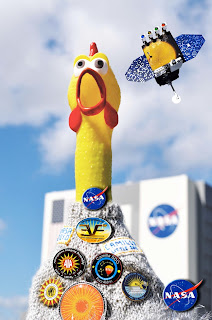
First, everyone's favorite interview question: tell us about yourself.
Does everyone get along?
This is a very diverse crew and I think Fuzz enjoys being a guy between two ladies! We all have our own talents and together we are a very strong team. Just like on a real NASA space mission, it takes getting used to each other. Team work is very important and I trust my crew completely.


You mentioned that you're particularly interested in doing science, technology, engineering, and math (STEM) education and in getting women interested in STEM careers. That's a mission of ScienceCheerleader.com (one of my other side jobs) as well. What do you do to encourage young women to pursue those careers? What's your primary message?
I think we should think about doing a project together. Like I said - building a community and working together we can achieve so much. Reality is that we need to have more women in STEM. Many times they are intimidated by the subjects or they don't always get the chances they deserve. But it's so important to encourage girls to pursue that career and show them that really not even the Sky is the limit.
Darlene Cavalier, the original Science Cheerleader, does interviews with pro cheerleaders, and she asks each of them if they're taken seriously because society has certain stereotypes or perceptions about cheerleaders. You're in a similar situation, as rubber chickens are traditionally seen in a comic relief role. Do you ever worry that people won't take you seriously as an advocate for STEM? How do you counteract that?
Of course there are always people who see me as just a rubber chicken. I see that as a positive challenge. Look, I have managed to train with the very last Space Shuttle crew, the STS-135 crew. I have spent time with the NASA Administrator and we talked about public outreach. I have managed to get stuck on the Space Potty thanks to Astronaut Clay Anderson. If I can achieve all of this, I should be taken seriously. And if a girl shows interest in math or science, that girl should immediately have the respect and support.
Anything else you'd care to share?
Here is the truth: we have one Space Shuttle launch left to go. After that we will not be launching humans from the US for some time. But that does not mean space exploration is dead. The ISS (International Space Station) continues to host astronauts. They will continue to do science up there and we will continue to learn about our solar system and our universe. Some amazing unmanned missions are coming up, like Juno. Juno will help us learn more about Jupiter. http://www.nasa.gov/mission_pages/juno/main/index.html
Life is beginning to return to normal, so what could be more natural than for me to conduct an interview with a rubber chicken? No, really...

First, everyone's favorite interview question: tell us about yourself.
Me? I am Camilla Corona SDO - a rubber chicken turned mission mascot for NASA's Solar Dynamics Observatory or SDO. I help with the Education and Public Outreach part of our mission! Little SDO is now in his orbit taking these incredible high resolution images of the Sun in many wavelengths. These images are 10x higher resolution than HD TV and really let us take a very close look at the Sun. I met Little SDO at NASA Goddard Space Flight Center many years ago and we established this very special friendship. I call him Little but he is actually the size of a small bus. For a year we have now gotten this amazing data and have already learned a little more about our Sun.
When I am not educating about the Sun and Space Weather, I do try to inspire kids to get more interested in science, engineering and space exploration. And since I want to go and visit Little SDO in Space, I have to go through a lot of training. I really enjoy that part and it allows me to get an inside look into human space flight. And I enjoy sharing my adventures and what I am learning in the process.
Learn about Little SDO here: http://sdo.gsfc.nasa.gov/
Or follow him on Facebook here: www.facebook.com/NASA.Little.SDO
Who makes your clothes?
One of my goals is to create a community. Little SDO and I want to be as engaging and interactive on social media as possible. That creates a community of people who not only want to learn, but they want to become involved. And I always say, you don't have to be fluent to speak the language. There are many ways people can help and get involved. And so it turns out that I have some amazing friends on social media who make me these amazing outfits. And in the process they get involved. They not only learn about what I do, but they tell their friends and then they get interested. And why not combine art and science? Art is science and there is art in science. And I end up as the best dressed rubber chicken there is! A rubber chicken isn't the first mascot one might think of when it comes to space weather. How did that come about?
Rubber chickens have been an important part of NASA, dating back to the Apollo days. Back then it was more of a way to let frustration out. There are stories of engineers smashing rubber chickens against the desks. What happened on SDO is that one day I walked down the halls of Goddard Space Flight Center and I saw this shiny spacecraft and it was friendship at first sight. So I was adopted as the mission mascot. Plus, I am yellow like the Sun! (which of course is not really the case since the Sun has no color). You have quite an interesting travel schedule. What sorts of events do you attend?
I do have a very busy schedule, with not only conducting a lot of training, but I also try to attend several events to connect with the people. I enjoy events with kids because it is really wonderful to see their inspiration and see their way of thinking. And I try to inspire our youth, especially girls, to explore their interest in science, technology, engineering and math. And I try to attend most of our NASA Tweetup events, where selected individuals are invited to get a real inside look into either a Space Shuttle launch, an unmanned mission or a NASA center. These are great opportunities to meet and connect with people. The power of social media is wonderful - it gives somebody like me a voice, a way to reach out.
I do have a very busy schedule, with not only conducting a lot of training, but I also try to attend several events to connect with the people. I enjoy events with kids because it is really wonderful to see their inspiration and see their way of thinking. And I try to inspire our youth, especially girls, to explore their interest in science, technology, engineering and math. And I try to attend most of our NASA Tweetup events, where selected individuals are invited to get a real inside look into either a Space Shuttle launch, an unmanned mission or a NASA center. These are great opportunities to meet and connect with people. The power of social media is wonderful - it gives somebody like me a voice, a way to reach out.
Several NASA missions now have critters of various sorts supporting or representing their outreach efforts. Do you see this as a trend?
I wasn't the first mission critter but I am the most active for sure. There is a trend. Just very recently Trigger got introduced with NASA's MMS mission. But not only within NASA can we now find mascots. AIAA (American Institute of Aeronautics Astronautics) has Skye Bleu, Bears On Patrol has Fuzz Aldrin. Both of them are part of my mission to the Edge of Space. Then there is my dear friend Spooner with NASA's Exploration Technology Development Program Office. And I cannot forget Luna, NASA Johnson's Space Center's mascot. And Boeing has Casey. 
So there is trend and one that makes sense. See, our goal is to get people involved, interested and take the intimidation factor out. Put a "human" face to the missions, the science and people are sometimes more interested and feel more comfortable to ask questions. It's wonderful.
You, Fuzz Aldrin (a teddy bear), and Skye Bleu (a flying pig) went on an actual flight mission. What's all that about? What did you do?
Last year I was contacted by the non-profit organization BearsOnPatrol.org and asked if I was interested in joining forces to promote science education and peace. We decided to plan a mission to the Edge of Space and make it like a real NASA mission. We decided to use a balloon to get us to 100,000 feet, add some cameras, tracking devices and a scientific instrument and use this as a way to not only educate about what is needed for this, but to show how easy it is to reach the Edge of Space. The goal is to get beautiful images of the darkness of Space and see Earth's curve. Also, we want to inspire parents and teachers to do a similar projects with their kids. After we created the mission patch and named the mission BTS-1 (Balloon Transport System - 1st Flight) the AIAA's mascot Skye Bleu joined us. And again, this is about building a community, educating about the various steps it takes to get a mission of the ground and have fun with it. And just today we had our Pre-Flight Medical exams. Just like real astronauts we went through a series of medical tests.
I am the Commander of the mission and am responsible for the overall mission success. Fuzz Aldrin is the Pilot and has gone through many mission sims in order to get us all back safe. Skye Bleu is our Mission Specialist and will be overseeing all the instruments on board our capsule. Our capsule was just named "Inspiration" - and we hope to just do that!
Does everyone get along?
This is a very diverse crew and I think Fuzz enjoys being a guy between two ladies! We all have our own talents and together we are a very strong team. Just like on a real NASA space mission, it takes getting used to each other. Team work is very important and I trust my crew completely.
Were you nervous about the flight?
I think I was more excited than nervous. There are many things that could go wrong but we must focus on the things that will go right. It is exciting to think about going up that high. It's not a first but it's a first by three mascots.
I think I was more excited than nervous. There are many things that could go wrong but we must focus on the things that will go right. It is exciting to think about going up that high. It's not a first but it's a first by three mascots.


Now looking back at our BTS-1 mission, I am glad we trained well. Like all astronauts, we did do survival training. We landed much further East than expected and managed to touch down in gator invested swamp land in Louisiana. We were out there for almost 5 days, waiting for rescue. Our ground team did an excellent job in locating us and getting us back home safe.

This was one of the lessons we tried to teach. Sometimes things just go differently during a mission. A team needs to adjust quickly and come up with solutions. Sometimes it's a life and death situation. Look at Apollo 13! A grim situation was turned around by working together and coming up with solutions. That's spaceflight for you! Teamwork. What you don't predict, you cannot prevent.
You mentioned that you're particularly interested in doing science, technology, engineering, and math (STEM) education and in getting women interested in STEM careers. That's a mission of ScienceCheerleader.com (one of my other side jobs) as well. What do you do to encourage young women to pursue those careers? What's your primary message?
I think we should think about doing a project together. Like I said - building a community and working together we can achieve so much. Reality is that we need to have more women in STEM. Many times they are intimidated by the subjects or they don't always get the chances they deserve. But it's so important to encourage girls to pursue that career and show them that really not even the Sky is the limit.
Darlene Cavalier, the original Science Cheerleader, does interviews with pro cheerleaders, and she asks each of them if they're taken seriously because society has certain stereotypes or perceptions about cheerleaders. You're in a similar situation, as rubber chickens are traditionally seen in a comic relief role. Do you ever worry that people won't take you seriously as an advocate for STEM? How do you counteract that?
Of course there are always people who see me as just a rubber chicken. I see that as a positive challenge. Look, I have managed to train with the very last Space Shuttle crew, the STS-135 crew. I have spent time with the NASA Administrator and we talked about public outreach. I have managed to get stuck on the Space Potty thanks to Astronaut Clay Anderson. If I can achieve all of this, I should be taken seriously. And if a girl shows interest in math or science, that girl should immediately have the respect and support.
I understand you're friends with my author friend Kate Doolan, who described you as a "classy chick." What are your interactions with her like?
Bart, the social media tools have enabled me to connect and interact with a wide variety of people. I met Kate a long time ago and I see her as one of my most special friends. I love her humor and I really admire her Apollo days knowledge. While we joke around often, we both admire each other and I have learned a lot from her. I hope she can say the same. But the beauty is that I can connect with so many wonderful people. And I get a chance to learn and listen to what they think.
Anything else you'd care to share?
Here is the truth: we have one Space Shuttle launch left to go. After that we will not be launching humans from the US for some time. But that does not mean space exploration is dead. The ISS (International Space Station) continues to host astronauts. They will continue to do science up there and we will continue to learn about our solar system and our universe. Some amazing unmanned missions are coming up, like Juno. Juno will help us learn more about Jupiter. http://www.nasa.gov/mission_pages/juno/main/index.html
MAVEN and MSL will both give us more clues about Mars and its atmosphere.
Get interested, get engaged, have fun with what we do. Reality is, we don't know much and have lots of stuff to learn.
If you want to learn more about me or follow my adventures:
Thanks!

Tuesday, March 29, 2011
Interview: Laura Eilers
 Let's start with something straightforward, like how did you get into cheerleading?
I was a dancer originally. I spent one year as a "real" cheerleader as a high school sophomore, then became an NFL cheerleader after college. My parents put me in dance at three years old because the pediatrician said I was highly uncoordinated ... I would run into walls, haha ... that hasn't changed!
You're a trainer and choreographer, too. Did that require any additional training/experience?
I have certification in personal training from NASM: The National Academy of Sports Medicine. I studied a very thick textbook and videos for about three months plus observation and on-hands training experience. I must be re-certified every two years through weekend workshops and always maintain CPR and First Aid certification. Teaching various fitness classes requires certification as well. I am trained in KidFit Yoga, Kickboxing, Strength & Step/Dance instruction. Each requires 1-2 weekends of training, a written and physical test. The good news is that anyone at any age and experience level can be a choreographer! I love teaching kids how to listen to musical accents and choose motions that fit to them.
What's a typical workout like for you?
I love to do all types of workouts. I like to spend 45-90 minutes really working hard. I take spinning class 1-2 times per week, run/elliptical 3-4 times per week, and lift weights 4-5 days per week. I really love taking boot camp classes, and I actually go to my own personal trainer once a week. My trainer makes me lift very heavy weights, I typically stay light with multiple reps, combined with plyometrics. I am a fitness freak!
The uniforms for the Science Cheerleaders are great! When did you start designing uniforms? What's your process on that--does a customer come to you with ideas, or do they just expect you to come up with "something different?"
Thank you! The Science Cheerleader uniform is called the "Starbright" design of Go Wild! Wear created by Angela King Designs. I have loved that piece since the moment I saw it, and I'm not sure it's ever been worn in those colors or especially with the atom logo belt buckle! I'm so honored to work with Angela, she is really the sole costume designer. Oftentimes I get to indulge in color or fabric selection, accessorizing, changing a strap here or there. I do especially enjoy helping audition candidates select attire... it's important to pick something flattering, unique and perfect for that team!
You won a Ms. Virginia pageant recently. Congratulations! Had you ever been in a pageant before? What was the experience like for you?

The more I work with SciCheer, the more I realize what a large community professional cheerleading really is. How did Darlene find you?
Oh wow ... Darlene has been so great! I think we connected on Alumnicheerleaders.com... that's a great online network allowing cheerleaders to post profiles and photos and message each other.
Your bio notes that you were on the TV show "Dallas Cowboys Cheerleaders: Making the Team." For those of us who didn't watch, what did you do on the show?
In 2009, I was a Dallas Cowboys Cheerleader semifinalist. I spoke on camera about how quickly we had to learn the routine and was shown dancing on the field of Texas Stadium. That was the coolest part of the auditions, as it was the last year the stadium was used. Being behind the scenes for those auditions was really educational! It makes you respect anyone who is on a reality series.
You've got two or three businesses going, in addition to the creative work you've done for Science Cheerleader. What are they?
First, I'm the director of Going Pro Entertainment, which offers pro cheer consulting, choreography, events and other team services. We have representatives who are amazing alumni from the NFL, NBA and AFL, located in over 20 major U.S. markets. We've done everything from host conventions to team image consulting to judging to audition management. Second, I direct the sales team for Go Wild! Wear, created by Angela King Designs. There are currently six sales reps, and I also work directly with customers on the east coast and in my home states of Kansas and Missouri. Finally, I reside in the city of Richmond, Va, where I'm a personal trainer, fitness and dance instructor. I direct the dance team for the Richmond Raiders arena football team, and I'm the game day field emcee!
Since we first talked at the Science & Engineering Festival, it's become quite clear that you're a very busy person. How do you manage to do it all? How do you relax?
My mom tells me that I have just always been this way. It's easy to stay busy when you truly enjoy your career! I have a constant checklist under my nose. I think my "saving grace" is working out daily and eating healthy. I probably don't "relax" as often as the average person, but when I do, I love going to the beach, wineries, mountains, and different parts of the world.
Anything else you'd like to share?
Bart Leahy is ScienceCheerleader.com's Cheer Operations Ninja and gopher.
I first met Laura, Science Cheerleader's Creative Director and Choreographer, while helping Darlene plan the Science Cheerleaders' debut at the Science & Engineering Festival last October. Like the cheerleaders she trains, Laura has a busy life to share, so I'll just get to it and let you learn for yourself.
*
I was a dancer originally. I spent one year as a "real" cheerleader as a high school sophomore, then became an NFL cheerleader after college. My parents put me in dance at three years old because the pediatrician said I was highly uncoordinated ... I would run into walls, haha ... that hasn't changed!
You're a trainer and choreographer, too. Did that require any additional training/experience?
I have certification in personal training from NASM: The National Academy of Sports Medicine. I studied a very thick textbook and videos for about three months plus observation and on-hands training experience. I must be re-certified every two years through weekend workshops and always maintain CPR and First Aid certification. Teaching various fitness classes requires certification as well. I am trained in KidFit Yoga, Kickboxing, Strength & Step/Dance instruction. Each requires 1-2 weekends of training, a written and physical test. The good news is that anyone at any age and experience level can be a choreographer! I love teaching kids how to listen to musical accents and choose motions that fit to them.
What's a typical workout like for you?
I love to do all types of workouts. I like to spend 45-90 minutes really working hard. I take spinning class 1-2 times per week, run/elliptical 3-4 times per week, and lift weights 4-5 days per week. I really love taking boot camp classes, and I actually go to my own personal trainer once a week. My trainer makes me lift very heavy weights, I typically stay light with multiple reps, combined with plyometrics. I am a fitness freak!
The uniforms for the Science Cheerleaders are great! When did you start designing uniforms? What's your process on that--does a customer come to you with ideas, or do they just expect you to come up with "something different?"
Thank you! The Science Cheerleader uniform is called the "Starbright" design of Go Wild! Wear created by Angela King Designs. I have loved that piece since the moment I saw it, and I'm not sure it's ever been worn in those colors or especially with the atom logo belt buckle! I'm so honored to work with Angela, she is really the sole costume designer. Oftentimes I get to indulge in color or fabric selection, accessorizing, changing a strap here or there. I do especially enjoy helping audition candidates select attire... it's important to pick something flattering, unique and perfect for that team!
 |
| Laura and Stephanie on the National Mall during the Science & Engineering Festival |
Actually this was my very first pageant! I'm really honored to have been selected. I felt pretty comfortable with the walking and speaking as I have done that often with my eight years auditioning for NFL cheerleading squads. I have some experience in fashion shows, swimsuit and gown modeling, too. It is quite different for me, because I'm used to being in a team environment, and when they announced the "winner" ... well this time it's just 'lil 'ol me! Everyone within the Miss United States pageant system has been very welcoming and uplifting.
 |
| Ms. Virginia United States |
What's it feel like to have one of those crowns put on your head?
It feels like a million bucks! ...but certainly doesn't cost that much :)

The more I work with SciCheer, the more I realize what a large community professional cheerleading really is. How did Darlene find you?
Oh wow ... Darlene has been so great! I think we connected on Alumnicheerleaders.com... that's a great online network allowing cheerleaders to post profiles and photos and message each other.
Your bio notes that you were on the TV show "Dallas Cowboys Cheerleaders: Making the Team." For those of us who didn't watch, what did you do on the show?
In 2009, I was a Dallas Cowboys Cheerleader semifinalist. I spoke on camera about how quickly we had to learn the routine and was shown dancing on the field of Texas Stadium. That was the coolest part of the auditions, as it was the last year the stadium was used. Being behind the scenes for those auditions was really educational! It makes you respect anyone who is on a reality series.
You've got two or three businesses going, in addition to the creative work you've done for Science Cheerleader. What are they?
First, I'm the director of Going Pro Entertainment, which offers pro cheer consulting, choreography, events and other team services. We have representatives who are amazing alumni from the NFL, NBA and AFL, located in over 20 major U.S. markets. We've done everything from host conventions to team image consulting to judging to audition management. Second, I direct the sales team for Go Wild! Wear, created by Angela King Designs. There are currently six sales reps, and I also work directly with customers on the east coast and in my home states of Kansas and Missouri. Finally, I reside in the city of Richmond, Va, where I'm a personal trainer, fitness and dance instructor. I direct the dance team for the Richmond Raiders arena football team, and I'm the game day field emcee!
 |
| Laura in a brief moment of relaxation |
My mom tells me that I have just always been this way. It's easy to stay busy when you truly enjoy your career! I have a constant checklist under my nose. I think my "saving grace" is working out daily and eating healthy. I probably don't "relax" as often as the average person, but when I do, I love going to the beach, wineries, mountains, and different parts of the world.
Anything else you'd like to share?
Well, on the subject of science ... I remember loving science and math when I was younger. My favorite memory is creating a cell model with my mom for a science project. We made the cell out of cookie cake, icing and other sweets. It's amazing how you can remember terminology when you label it in frosting! I love spending time with the Science Cheerleaders during our events. They are such amazing, intelligent women, role models not only in the field of cheerleading and dance but to girls and women everywhere.
Thanks for taking the time to do this!
Thank YOU Bart!
Bart Leahy is ScienceCheerleader.com's Cheer Operations Ninja and gopher.
Monday, July 12, 2010
Interview: Meg Tuma, Scientist and Mentor
In the course of doing my job, I frequently get to work with a lot of very smart people, among them Margaret L. (Meg) Tuma, Ph.D., one of the engineers ("rocket scientists") at Marshall Space Flight Center.
What do you do at Marshall Space Flight Center?
I’m the project lead for the Ares I Integrated Vehicle Ground Vibration Test. That’s a mouthful – and means I’m responsible for the modal test on the new Ares rocket. We need to understand the natural frequencies and damping of the Ares V vehicle in order to adequately control the vehicle during ascent and flight. My responsibilities include getting the test rocket hardware from each of the rocket component elements (First Stage, Upper Stage, Upper Stage Engine, and Orion), coordinating transportation to MSFC and the Test Stand, getting the Test Stand (4550) ready for testing, the hydrodynamic stands (ie big shock absorbers), stacking the hardware, conducting the test, and disassembling the vehicle.
What degrees do you have? B.S. Physics, M.S. Physics, Ph.D. Electrical Engineering
Did you pursue these degrees with space in mind? Always in the back of my mind, but not my ultimate goal. I really didn’t think I had a chance to work at NASA, so when I got the opportunity, I jumped on it!
When did you know you wanted to work in a scientific or technical field?
In high school. I always liked math and science and in high school was challenged in physics and calculus and realized that’s what I wanted to pursue in college.
How did you make the switch from research to management?
I was in the NASA Professional Development program in 2000-2001. During that year, I worked at JPL, a University, and HQ. These experiences broadened my horizons and made me realize my talents would be put to better use if I shifted from research into project management. It was a fairly smooth transition. Although, I miss research from time to time. I still work on one of my inventions in my “spare” time. It’s a miniature light bulb (aka a “light bulb on a chip”) that can be used as a calibration source for spectrometers on satellites or remote terrestrial applications.
What's the biggest difference between science and engineering?
Engineering is much more applied. Science is a broader field trying to understand nature at its core (forces, electricity, etc.) Engineering takes science and applies it to make things work.
What advice would you give to young women interested in pursuing STEM careers?
Study study study! In groups if you can find a good study group. Take an internship or summer job in the field you are pursuing to “test drive” it. It’s much easier to change a major to match the career you’re interested in. Get a mentor. This is really important. There are several mentoring programs. One is MentorNet – an online mentoring program.
You participate in a mentoring program through the University of Akron. What can you tell me about that experience?
It’s wonderful! Each year I’m paired with one or more students and meet with them in person monthly usually at a social event (bowling, touring a museum, etc) and via email on a weekly basis. In fact, I’m still in contact with students I mentored 10 years ago! I was able to help them with class choices, provide career advice, and just listen to their problems when they needed to talk. I like helping others so I find it very fulfilling. I’m also a charter member of MentorNet – an online mentoring program where I’m paired with a graduate student in the US and we communicate via email a few times a month. My current mentee is in California and had a side project working on research for microwave popcorn. It was very interesting. I’m also involved in the “Adopt-A-Physicist” program. Twice a year I get paired with 2 or more high school classes from across the US and communicate via email. They ask lots of questions! Like, what made me decide to go into my current career, my favorite class, most interesting work experience, toughest work experience, etc. I was mentoring 3 classes during the Ares I-X launch, and they were tracking the progress and stopped their school work to watch the launch. It was neat to share that excitement with so many young students.
In addition to technical knowledge, what skills have you found the most valuable in your career?
People skills! It is so important to understand how to manage a team and understand your team’s personal dynamics.
What's been the coolest moment in your career so far?
Ares I-X launch. Followed by aero flight tests. And riding in the vomit comet.
Where do you go from here?
The moon! Still trying to be an astronaut. Hopefully we’ll have a replacement vehicle for the shuttle to take us there.
In the course of doing my job, I frequently get to work with a lot of very smart people, among them Margaret L. (Meg) Tuma, Ph.D., one of the engineers ("rocket scientists") at Marshall Space Flight Center.
What do you do at Marshall Space Flight Center?
I’m the project lead for the Ares I Integrated Vehicle Ground Vibration Test. That’s a mouthful – and means I’m responsible for the modal test on the new Ares rocket. We need to understand the natural frequencies and damping of the Ares V vehicle in order to adequately control the vehicle during ascent and flight. My responsibilities include getting the test rocket hardware from each of the rocket component elements (First Stage, Upper Stage, Upper Stage Engine, and Orion), coordinating transportation to MSFC and the Test Stand, getting the Test Stand (4550) ready for testing, the hydrodynamic stands (ie big shock absorbers), stacking the hardware, conducting the test, and disassembling the vehicle.
What degrees do you have? B.S. Physics, M.S. Physics, Ph.D. Electrical Engineering
Did you pursue these degrees with space in mind? Always in the back of my mind, but not my ultimate goal. I really didn’t think I had a chance to work at NASA, so when I got the opportunity, I jumped on it!
When did you know you wanted to work in a scientific or technical field?
In high school. I always liked math and science and in high school was challenged in physics and calculus and realized that’s what I wanted to pursue in college.
How did you make the switch from research to management?
I was in the NASA Professional Development program in 2000-2001. During that year, I worked at JPL, a University, and HQ. These experiences broadened my horizons and made me realize my talents would be put to better use if I shifted from research into project management. It was a fairly smooth transition. Although, I miss research from time to time. I still work on one of my inventions in my “spare” time. It’s a miniature light bulb (aka a “light bulb on a chip”) that can be used as a calibration source for spectrometers on satellites or remote terrestrial applications.
What's the biggest difference between science and engineering?
Engineering is much more applied. Science is a broader field trying to understand nature at its core (forces, electricity, etc.) Engineering takes science and applies it to make things work.
What advice would you give to young women interested in pursuing STEM careers?
Study study study! In groups if you can find a good study group. Take an internship or summer job in the field you are pursuing to “test drive” it. It’s much easier to change a major to match the career you’re interested in. Get a mentor. This is really important. There are several mentoring programs. One is MentorNet – an online mentoring program.
You participate in a mentoring program through the University of Akron. What can you tell me about that experience?
It’s wonderful! Each year I’m paired with one or more students and meet with them in person monthly usually at a social event (bowling, touring a museum, etc) and via email on a weekly basis. In fact, I’m still in contact with students I mentored 10 years ago! I was able to help them with class choices, provide career advice, and just listen to their problems when they needed to talk. I like helping others so I find it very fulfilling. I’m also a charter member of MentorNet – an online mentoring program where I’m paired with a graduate student in the US and we communicate via email a few times a month. My current mentee is in California and had a side project working on research for microwave popcorn. It was very interesting. I’m also involved in the “Adopt-A-Physicist” program. Twice a year I get paired with 2 or more high school classes from across the US and communicate via email. They ask lots of questions! Like, what made me decide to go into my current career, my favorite class, most interesting work experience, toughest work experience, etc. I was mentoring 3 classes during the Ares I-X launch, and they were tracking the progress and stopped their school work to watch the launch. It was neat to share that excitement with so many young students.
In addition to technical knowledge, what skills have you found the most valuable in your career?
People skills! It is so important to understand how to manage a team and understand your team’s personal dynamics.
What's been the coolest moment in your career so far?
Ares I-X launch. Followed by aero flight tests. And riding in the vomit comet.
Where do you go from here?
The moon! Still trying to be an astronaut. Hopefully we’ll have a replacement vehicle for the shuttle to take us there.
Thursday, March 19, 2009
A Conversation with Ray Kurzweil
Darlene Cavalier and Bart Leahy
 The questions below were submitted by our readers. Some questions were edited or combined for content. We appreciate your participation in the ongoing discussion about the Singularity. (Note: Hyperlinks added by Bart for reference.) Our thanks to Ray Kurzweil for taking the time to respond to our queries.
Darlene Cavalier and Bart Leahy
 The questions below were submitted by our readers. Some questions were edited or combined for content. We appreciate your participation in the ongoing discussion about the Singularity. (Note: Hyperlinks added by Bart for reference.) Our thanks to Ray Kurzweil for taking the time to respond to our queries.
General and Technical Questions – What Is the Singularity?
1. What is your “short version” definition of what the Singularity is?
–Bart
RAY: The Singularity is a future time when the pace of technological change will be so fast and transformative that you will not be able to follow it unless you merge with the intelligent technology we are creating.
2. Singularity University is clearly aimed at helping to shape the Singularity and hasten its arrival. Do exponential trends really need help and, if so, can we really expect to shape them?
–Jon
RAY: The exponential growth of information technologies will continue inexorably as it has for over a century. However, technology has always been a double-edged sword ever since we developed fire and stone tools. How we apply these technologies and whether constructive applications that overcome human suffering and extend our creativity predominate over destructive applications is not preordained. That is where we can help shape the Singularity.
3. How would we recognize the Singularity happening? Would the change be gradual, or would it be similar to the singularity around a black hole--so enormous, rapid, and widespread that we wouldn’t even realize what had happened until long after we’ve crossed the point of no return?
–Marianne
RAY: The pace of information technology is continual yet exponential. Exponential trajectories have no discontinuities but are nonetheless disruptive. You describe the changes well as “enormous, rapid, widespread,” and constituting a “point of no return.”
4. Given the slow and erratic progress in AI over the past 40 years, what makes you so confident that machines will become intelligent (in the commonly understood sense) in the next 40?
–Corey
RAY: I disagree with your characterization of AI. It reminds me of people who go into the rain forest and ask, “where all the species that are supposed to be here” when there are 25 species of ants within fifty feet of them. The species in the rain forest are not seen because they are hidden in the ecostructure. Similarly, AI is all around us yet hidden in our modern economic infrastructure. Every time you send an email or connect a cell phone call intelligent algorithms route the information. Pick up a product, it’s been designed at least in part by intelligent computer assisted design software, inventory levels controlled by intelligent just-in-time inventory systems, assembled in robotic factories. AI software flies and lands airplanes, guides intelligent weapons system, automatically detects credit card fraud, helps you find information on the web, diagnoses electrocardiograms and blood cell images comparable to trained physicians, and much else. If all the AI programs were to stop tomorrow, our modern infrastructure would grind to a halt. That was not the case just fifteen years ago. These were all research projects then. On the research front, AI programs can now play master levels of go, drive cars with no human drivers through complex terrains, recognize songs and images, and so on. Now that we can see inside the brain with very high resolution we are building models and simulations of brain regions. That will accelerate AI in the years ahead.
Ethical and Social Questions
5. Why do you think it’s a good idea for us to create machines that are smarter or more powerful than human beings? Can we expect singularity to shape itself or will we still hold charge of our technological creations?
–Bart/Jasmin
RAY: The machines are not an alien invasion from Mars. It is part of our civilization which is already a human-machine civilization. Ever since we picked up a stick to reach a higher branch, our tools have been extensions of ourselves. We are the only species that changes who we are based on tools we create.
6. Suppose that things continue in much the way they are now, with increasingly powerful and miniaturized wireless devices making information available wherever we want it. Does that count as a “Singularity?” It is easy for me to imagine, for instance, a brain implant that allows me to conduct Google searches purely by the power of thought—but that merging of biological and digital intelligence seems distinctly different from what you mean by a Singularity.
–Corey
RAY: Accessing the web from inside our brains is one good example of what we will see in about twenty years.. The machine extensions to our brains will grow exponentially both in hardware and software capability. By the late 2030s, it will be the nonbiological portion of our intelligence that predominates.
7. How do you see the economics of the future working/changing if everything is free?
–Bart
RAY: Who said everything will be free? We will continue to have open source and proprietary sources of information. When we have nano desktop factories that can produce physical products from information files and very inexpensive input materials, we will be able to live very well on just open source information. But there will still be an edge and demand for proprietary information. Information technologies have had an 18 percent growth rate as measured in constant dollars for the past fifty years despite the fact that you can get twice as much of it for the same cost every year. This in fact has been the source of true economic growth.
8. How close are we to getting a Star Trek-like “holodeck?”
–Jonathan
RAY: In twenty years we will be able to produce physical products from information files using nano desktop factories. This is still short of the holodeck but it will turn virtually the entire economy into an information economy.
9. How far away are we from reaching the Singularity? Is 2045 still a reasonable estimate?
–Jason
RAY: According to my models, we will multiply our biological intelligence a billion fold through its integration with nonbiological intelligence by 2045. I consider that the Singularity.
10. How do you respond to people who claim that this is just “the geek Rapture?”
–Bart
RAY: This “criticism” is based on the notion that the “rapture” came first and that we just worked backwards to justify this religious notion. But that is not where the ideas come from. They come from a scientific analysis of technology trends. Religion emerged in pre scientific times and we do need to update our philosophies based on science.
11. What is to become of people who don't want to join your Singularity and just want to remain human as they are?
–Bart
RAY: First of all, it is human to change who we are. We didn’t stay on the ground, we didn’t stay on the planet, and we have not stayed with the limitations of our biology. Human life expectancy was 23 a thousand years ago. We are the only species that changes who we are and extends our reach, both physical and mental, through our tools. So it is human to change who we are. There will always be early and late adopters, but people are not going to completely dismiss these changes. How many people today complete reject medical and health technologies? When there is a therapy based on blood cells devices that overcome a particular disease, very few if any people will reject it. People put computers in their brains today if they have Parkinson’s Disease. People do not reject this FDA approved therapy due to philosophical issues.
12. Are you pleased or disappointed with the progress made so far? What technologies are “ahead of the curve,” as you see it, which ones are behind?
–Jason
RAY: My team and I just updated the graphs that were in my 2005 book The Singularity is Near from 2002 through 2007. The exponential curves have remained precisely on track. It is pretty remarkable when you consider that what we are measuring is the innovation of millions of people.
13. Your book takes a very optimistic view of science and human nature, but neglects the problem of human evil. Given what we've done with previous “great inventions,” don't you worry that individuals or nations could do great harm with all this—accidentally or maliciously? What safeguards would be put in place to prevent this?
–Bart/Ned
RAY: I don’t know why people say I ignore the downsides when I was the one who initiated the debate about promise versus peril. Bill Joy’s WIRED cover story “Why the Future Doesn’t Need Us” was based on my book The Age of Spiritual Machines, as he acknowledges at the beginning of the article. My recent book, The Singularity is Near, has an extensive discussion of the downsides and what to do about them in chapter 8 (“The Deeply Intertwined Promise versus Peril of GNR”). The safeguards we need are twofold. We need ethical standards for responsible practitioners such as the Asilomar guidelines in biotechnology. And we need a rapid response system, basically a technological immune system, to deal with intentional abuse. We have such a system for software viruses. I am working with the U.S. Army on putting a rapid response system in place for bioengineered biological viruses.
14. What is/will be the relationship between ethics and The Singularity? The rapid growth of science/knowledge leads to many advancements via engineering, but how can/will ethics be applied when mankind can no longer keep pace?
–Paul
RAY: See my response to the previous question.
15. What are your foundational core values....specifically your belief about God and how that guides the limits of what you do?
–Rosalind
RAY: I believe that evolution is a spiritual process in that it leads to greater intelligence, creativity, beauty, and love, all of the attributes that God has been called without limit. I believe we have a responsibility to apply our ideas to overcome human suffering. We have made good progress on this. Just read Thomas Hobbes on what human life was like a few hundred years ago. He described it as short, brutish, disaster prone, disease and poverty filled. Human life expectancy was 37 just 200 years ago.
16. Space exploration is one technology you downplay in The Singularity is Near. Does your new venture with Peter Diamandis and NASA—the Singularity University—change this perspective?
–Bart
RAY: Space travel will be of key importance once we saturate the matter and energy in our midst at the physical limits of computation. We will then need to spread out to the rest of the galaxy and universe. But we will not sending missions of squishy creatures, but rather missions of nanobots swarms..
17. What is the purpose of “Singularity U?”
–Bart
RAY: The purpose of Singularity University is to bring together the most creative students and professors to study exponentially growing information technologies and to apply these ideas to meeting the grand challenges of humanity.
18. What should people do about scientific literacy so that everyone can understand, at least a basic level, the rapidly advancing technology?
–Paul
RAY: Indeed, scientific literacy needs to be a core goal of our educational system. Other countries are taking that more seriously than we are. About twenty years ago, the U.S. graduated about 60,000 engineers per year and China graduated about 10,000. Now, we graduate about the same level and China graduates about 300,000 per year.
19. What should we be *doing* about all this?
–Dan
RAY: Celebrate science and engineering as the cool subjects that they are. It is only the exponentially growing information technologies that have the scale to address the major problems of humanity.
20. In 1999, you created a hedge fund called "FatKat" (Financial Accelerating Transactions from Kurzweil Adaptive Technologies) which began trading in 2006 to recognize patterns in "currency fluctuations and stock-ownership trends" and eventually beat the best human financial minds at making profitable investment decisions. Did FatKat predict the market collapse?
–Darlene
RAY: The FatKat algorithms are designed to only predict a few hours or days ahead and to do that with an accuracy that is somewhat better than chance.
21. Between the Reading Machine and the newest pocket-sized device designed to aid blind people by reading written text aloud, you’ve demonstrated a remarkable desire to help the blind. I’m curious: what sparked your interest in helping the blind?
–Darlene
RAY: In the mid 1970s I had developed a method that could recognize print in any typestyle. It was a solution in search of a problem. I happened to sit next to a blind guy on an airplane who said that his only real handicap was the inability to read ordinary print. That sparked my desire to apply this technology to build a print-to-speech reading machine..
22. You are making a movie due for release this year called The Singularity is Near: A True Story About the Future, part fiction, part non-fiction, in which you interview 20 big thinkers like our friend Marvin Minsky. I assume Marvin shares your vision on what Singularity is and will be. Do most “futurists” share your vision? Why or why not?
–Darlene
RAY: There is increasing awareness of my exponential view, but linear thinking is actually hard wired in the brain. So even otherwise sophisticated scientists often project current trends linearly into the future. They just have not studied technology trends. There is a profound difference between the intuitive linear perspective and the historically accurate exponential view. If I take thirty steps linearly (1, 2, 3, 4, 5, …) I get to 30. If I take thirty steps exponentially (2, 4, 8, 16, 32, …) I get to a billion. The latter sequence describes what has already happened. When I was a student at MIT we all shared one computer. The computer in your cell phone today is a million times cheaper than the one we all shared when I was a student, and is a thousand times more powerful. That’s a billion fold increase in price performance since I was a student and we will do it again in the next 25 years. This applies not just to computation but to any technology where we can measure the underlying information properties such as bits moved around on the Internet, genetic sequencing, brain sequencing, and much else.
23. The “part non-fiction” subplot in your movie includes a computer that saves the world from self-replicating, tiny robots. Are you concerned that such microscopic robots will pose a threat to the world?
–Darlene
RAY: Yes, that is called the grey goo scenario, and the narrative thread in the movie illustrates this danger.. I do think we can manage that through a combination of ethical standards to build in safeguards into nanotechnology, as well as a rapid response system that detects threats and immediately deals with them, just like our biological immune system is designed to do. But this is not something we should be sanguine about. We need to be very diligent about it.
24. I understand it had been documented that one of your goals is to bring back your late father using AI. How can that happen?
–Darlene
RAY: Future AI’s will be intelligent to gather all of the information about a deceased person (his DNA from his gravesite, memories of people who knew him, archived records) and create a person (say a virtual person in a realistic virtual reality environment) very similar to that person, basically someone indistinguishable from that person to the people who knew him or her. For this reason I have kept about fifty boxes of my father’s archives, all of his music, letters, photographs, movies, etc. Would this person be the same person as my father, or a new person that just happens to be very similar? You can argue that if my father lived, he would be very different anyway. We change our particles every six months or less, but there is a continuity of pattern. I discuss this philosophical issue in chapter 7 of The Singularity is Near.
25. Lastly, you were clearly influenced by your parents’ and uncle’s careers. Are your children working in science/engineering fields?
–Darlene
RAY My son Ethan, age 29, works as a venture capitalist for Bessemer Ventures in Silicon valley in the area of high tech business. I often talk to him about my business strategies. He is not an inventor but he is fostering technology innovation. My daughter is a writer and artist and is writing a graphic novel as her senior project at Stanford. Interestingly, I majored in both computer science and creative writing at MIT.
Wednesday, March 18, 2009
Various Links, News, and Outrages
A plain-language explanation of the value of social media.
Germany has something every guy can appreciate: man parks! An opportunity for grown men to play in the dirt with real construction equipment.
Care to know who else has taken bailout money? Here's the list of other companies Congress is likely to denounce for operating with no strings after first pledging money to bail them out with no strings attached: http://www.usatoday.com/money/economy/tarp-chart.htm. Stand by for more outrage, show trials, forced confessions, blacklists, and disingenuous demonizing.
Nancy Pelosi believes that Immigration raids of worksites to look for illegal workers are un-American.
Science fairs in Alabama (just in case you're interested):
A plain-language explanation of the value of social media.
Germany has something every guy can appreciate: man parks! An opportunity for grown men to play in the dirt with real construction equipment.
Care to know who else has taken bailout money? Here's the list of other companies Congress is likely to denounce for operating with no strings after first pledging money to bail them out with no strings attached: http://www.usatoday.com/money/economy/tarp-chart.htm. Stand by for more outrage, show trials, forced confessions, blacklists, and disingenuous demonizing.
Nancy Pelosi believes that Immigration raids of worksites to look for illegal workers are un-American.
Science fairs in Alabama (just in case you're interested):
A friend of mine from Disney is doing some email marketing of his own comic book. I thought I'd pass it along in case you're interested: Deus ex Comica: The Rebirth of a Comic Book Fan
While America seems to be lurching along to the left, New Zealand has elected a center-right government, and has a pretty impressive list of accomplishments for their first "100 days."
"Tea Parties" are expanding nationwide. Because the protests are often anti-Obama, the mainstream media, of course, is ignoring them unless they're also denouncing businesses.
I am now officially famous. I've been interviewed by The Space Show as a space advocate and The Story Institute as a nonfiction writer.
*
Doc and I had a really good discussion today about the Internet business model and how newspapers could make the transition beyond the dead-tree model. I asked him directly how writers like Scalzi and Doctorow will manage to make a buck once the dead-tree route is no longer available. (Side editorial: I believe some bright soul in the Obama administration will attempt to force the demise of paper books in the name of protecting the environment. Sure, a bunch of people at Barnes & Noble and Borders will lose their jobs, but Amazon will make out just fine with its Kindle editions. Okay, done with that--we now return you to your previously scheduled foolishness.)
One example Doc offered was Salon.com, which manages to hire and get good (albeit liberal) investigative pieces, to pay its writers, and get people to pay for their content. They have advertisers, and manage to bring in the big bucks, etc. So couldn't the big-name newspapers follow that same model? Or couldn't the NY Times, etc., make Kindle and the internet their primary for-pay distribution channel? "Perhaps," sayeth The Doc.
My follow-up question was, "What about new writers?" Getting paid for writing is difficult enough in the dead-tree era. How do writers without publishers get paid? Well, "that'll probably involve a long time writing for free." Yep. That was my guess. Anyhow, Doc is right that "Content is King," and that if your content is good enough, you can give some of it away and still make money on it.
Subscribe to:
Posts (Atom)